- Details
- Written by: interGen support
- Category: Bi-State Regional Commission
- Hits: 9771
Nearly 50 years ago, the 1964 Civil Rights Act was enacted. There continues to be an on-going need for awareness and implementation of this and new regulations related to civil rights. Gena McCullough, Planning Director, reviewed the Bi-State Title VI Program and Non-Discrimination Policy provided to the Commissioners.
The document is a consolidation of the various parts of the agency’s policies and procedures formalized collectively into one format.
Title VI states “No person in the United States shall, on the
ground of race, color or national origin, be excluded from
participation in, be denied the benefits of, or be subjected to
discrimination under any program or activity receiving Federal
financial assistance.” Additional non-discrimination requirements
include Executive Orders (EO) to address environmental justice in
minority and low-income populations (EO 12898), to improve access to services for persons with limited English proficiency (EO 13166) and to ensure consistent and effective implementation of Title VI (EO 12250) administered through the Department of Justice. There are other statutes that address protected classes related to age, sex, marital status, disability, etc.
The document identifies the Executive Director as the Title VI Coordinator, outlines roles and responsibilities and related documents, such as the public involvement process, language assistance, and handling of complaints. The Bi-State Regional Commission Title VI Program and Non-Discrimination Policy applies to agencywide programs and planning. It provides the framework for open and inclusive planning processes, outreach to low-income and minority populations, eliminating barriers to participation, providing broad representation on planning and advisory bodies where possible, knowing the socio-economic makeup of the Bi-State Region to address, and being proactive in agency programs and planning. Commissioners approved the policy for submission to the respective federal agencies.
- Details
- Written by: admin
- Category: Bi-State Regional Commission
- Hits: 46670
About the Bi-State Joint Purchasing Council
Members of the Bi-State Regional Commission created the Joint Purchasing Council (JPC) through an intergovernmental agreement in 1987. To become a voluntary member of the Joint Purchasing Council cities or Counties must be a member of the Bi-State Regional Commission. Membership also requires approval and signing of the JPC Intergovernmental Agreement by all parties. The local governments’ membership dues to the Commission support the program. Entities associated with a local government are able to participate with the approval of the local government.
The mission of the Council is to lower costs by volume buying through a competitive bidding process for the goods and services, reduce duplicative administration costs, and provide for the exchange of information and expertise among purchasers.
The Council believes in quality buying, which is the buying of materials, goods or services, which will fulfill but not exceed the requirements for which the goods are intended. Buying proper quality depends on having proper specifications and checking material brought against the specifications.
This forum is used to inform Council member governments of joint purchases of the Council and other purchasing activities. Educational presentations on the items they intend to purchase and industry changes are held as needed.
Joint Purchasing Council Members
All listed members of the Joint Purchasing Council are eligible to submit items for bid. They are also eligible to purchase any and all items listed in each bid document whether or not they submitted items into the bid document. The following entities are eligible to participate in the Joint Purchasing Council:
Iowa: Bettendorf, Buffalo, City of Muscatine, Davenport, LeClaire, Muscatine County, Scott County, Walcott, Waste Commission of Scott County
Illinois: Aledo, Alpha, Carbon Cliff, Coal Valley, Colona, Cordova, East Moline, Geneseo, Hampton, Hillsdale, Milan, Moline, Port Byron, Rapids City, Rock Island, Sherrard, Silvis, Henry County, Rock Island County, Vibrant Arena at The MARK
Program Information for Suppliers:
The products and services the local governments buy shall meet all he specifications supplied and the vendor agrees to provide. This will help the Council’s bid participants obtain quality products and services that minimize expenses, contribute to cost control and in many instances a greener and healthier workplace.
The Council’s bid participants all use authorized purchase orders or letters of confirmation for all purchases after the bid is awarded. The Bid Tabulations and award letters are not contracts for the purchase of the goods or services. Only, authorized purchase orders or letters of confirmation are contracts for purchase. All deliveries must made according to delivery instructions provided by participants.
The Joint Purchasing Council reserves the right to reject any and all bids, to waive irregularities in a bid, or to accept the bid which, in the judgment of the bid participants, is in the best interest of the Joint Purchasing Council bid participants.
- Details
- Category: Bi-State Regional Commission
- Hits: 27256
With growth and economic development goals, elected officials and community staff are challenged to meet infrastructure needs, implement land use controls and manage community resources wisely and cost effectively. Bi-State staff can provide assistance with information and resources on comprehensive planning, zoning and subdivision regulation, land use planning, infrastructure and service planning and implementation, annexation studies, etc.
Capital Improvement Programs help prioritize project needs and available funding, and include multiple-year plans to accomplish projects.
American Planning Association (APA) audio conference series on planning issues will be hosted by State Regional Commission for a fifth year.
Future Land Use consolidated for the Quad Cites Metropolitan Area.
Grant Applications are done for infrastructure, public facilities, law enforcement programs, housing rehabilitation, economic development projects, parks, recreation and open space efforts, riverfront enhancements, and solid waste/recycling programs.
Grant Management is done for any type of awarded project, maintaining compliance with all applicable state and federal guidelines and requirements.
Greenway Plans have been completed for several counties in the Bi-State Region, as well as the Quad Cities Metropolitan Area.
Household or Resident Surveys of community needs and demographic characteristics including survey development, distribution, compilation, tabulation and analysis are important for decision-making and grants.
Park and Recreation Planning, either system or master plans, are done on a community-wide or site plan basis.
- Details
- Category: Bi-State Regional Commission
- Hits: 54189
Bi-State is: A local, voluntary organization of 5 counties and 47 municipalities. Bi-State is not: Another layer or higher authority of government; nor is Bi-State created, controlled, or maintained by the federal or state governments.
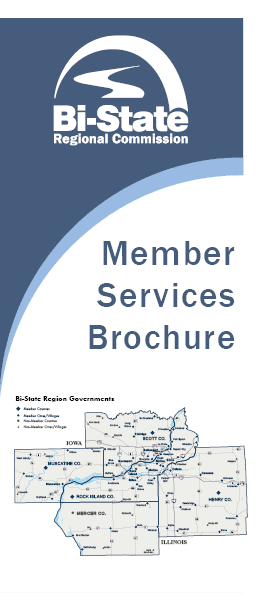
To view the brochure, click on the link below or the picture to the right.
BSRC Member Services Brochure, 2022